-
 Location
-
North America
-
Latin America
-
Asia Pacific
- |
- Sales & Service Partners
- |
- Contact Us
- |

AEROSPACE TECHNOLOGIES
Your browser is not supported.
For the best experience, please access this site using the latest version of the following browsers:



By closing this window you acknowledge that your experience on this website may be degraded.
Honeywell Aviation Reliability





7
|
Request Process for Cleaning and Summarization |
|
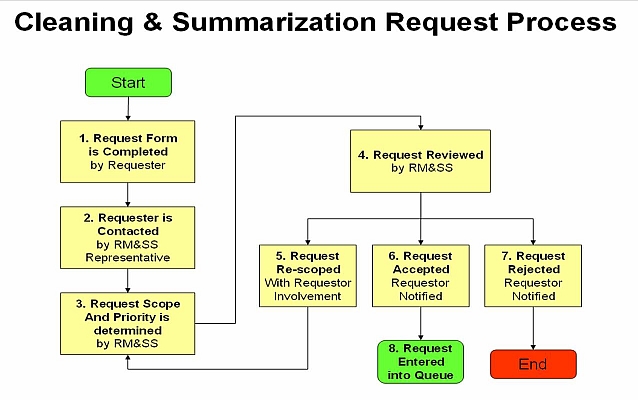
The following process is used by RM&SS to process data cleaning and summarization requests: Note: The numbered steps below represent steps in the Flow Chart below: 1. The user (requestor) submits a "Cleaning & Summarization Request" via HAvRel. The link is located on the Help Screen after logging into HAvRel. You will be required to login to HAvRel before you can fill out the form. 2. The request is sent to the RM&SS "New Part Request" Program Manager. The requestor will be contacted to confirm that the request was received and to obtain additional information if it is required. 3. RM&SS will determine the priority, scope, and resources required to complete the request relative to all requests currently in queue to be worked. 4. The request will be reviewed by a RM&SS review team to determine one of three outcomes: 5). Re-scope request: The requestor will be contacted to determine an acceptable re-scope of the request so that rejection does not occur. 6). Accept request: The requestor will be notified of the acceptance and a confirmation of estimated delivery date will be communicated. 7). Reject request: The requestor will be notified with the basis for rejection. In most cases requests will not be rejected, and will be re-scoped to try to meet the needs of the requestor. However, in the cases where accurate summary calculations cannot be delivered to the requestor due to inadequate or incomplete data sources, the request will be rejected. 8. Upon request acceptance in step 6 above, the request will be assigned resources and placed into queue for completion. Please note that due to shifting priorities and resource constraints, estimated delivery dates may change. However, RM&SS will communicate any change of expected delivery dates when they occur. |
|
|
Summarization Process to Create MTBUR(x) and MTBF(x) type Data |
HAvRel users who need summary data to perform their jobs are encouraged to go through this information and try to provide the needed static information up front. If we can get most of the static data collection done early in the process, it greatly speeds up the ability to generate new summary data or update data on HAvRel. |
|
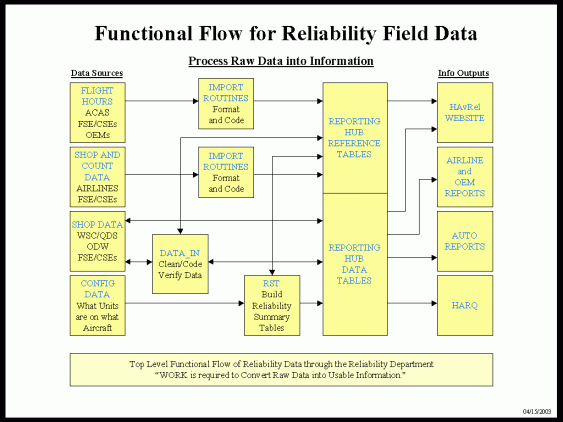
Summary data, i.e. MTBUR or MTBF is generated using three separate inputs, each of
which must be clean and complete. The work which must be expended to create summary
data is partially completed by RM&SS and partially by the party(ies) requesting the
data. In order to generate the summary data for an LRU, we need to know the following about the customer/fleet, i.e. Southwest:737-300, to be summarized: 1. Flight Hours for the requested customer/fleet (usually this is available via ACAS, if not it must be supplied by the requestor.) 2. Counts of Removals and Confirmed (either Honeywell Shop repair records or counts from the Airline typically provided by the requestor or FSE) a) Honeywell Shop Repair Records - in order to use this data, all the repairs must be completed at a Honeywell shop or the data must be loaded into the Honeywell shop data system. The customer should not be screening any units before sending them to Honeywell for repair. b) Airline Count Summary Data - When Honeywell shop Repair Records can't be used, we must use Airline Count Summary Data. This data is provided by the FSE or requestor. RM&SS will supply a spreadsheet for this data. 3. Configuration Information for each customer/fleet (provided by the requestor/FSE) This data includes: a) Quantity per Aircraft (QPA) - if this data varies from plane to plane within the customer/fleet then we need a "best" estimate of the QPA average for the fleet. b) Fleet Penetration - if alternate part numbers are used in the customer/fleet application then we need to know the percentage of the fleet penetration for the part number of interest. We use this percentage to determine the applicable flight hours for our calculations. The fleet configuration data should be updated on a periodic basis, especially if customer/fleets are changing sizes or ramping equipment in or out. When all the inputs are in place and correct, the reliability group can generate summary data and place it on HAvRel. |
|
 |
Contact Part Request Process Owner: Mike Sicz |